|
News of breaking thoughts and random enthusiasms.
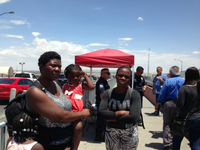
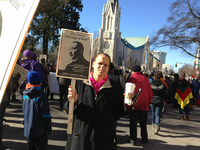
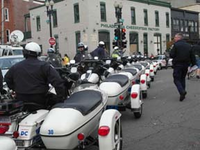
The November 17 Occupy DC march to Key Bridge was remarkable for its peacefulness, while in the rest of the country, Occupiers were getting arrested, clubbed and pepper sprayed. Few in DC wanted to really block the bridge. In DC, it would be a federal crime, while other spans like Brooklyn Bridge and the Steel Bridge in Portland are only covered by local laws. This march showed a lot of labor support, which could be crucial for keeping the Occupy Movement going over the winter.
More Photos Here
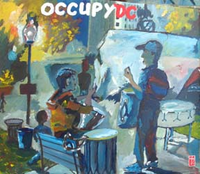
I found some lively art work down at the occupy DC encampment in McPherson Square. DC artist Ray Voide did a nice job of capturing the spirit of the encampment in his acrylic-on-cardboard paintings. The Rosa Parks banner was especially striking.
More Photos Here
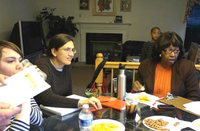
I went down to visit the Occupy DC folks in McPherson Square a few days ago. Amongst the unwashed and the over-educated I found a startlingly diverse group of middle class strivers, residents of suburban cul-de-sacs, left-leaning professionals and even a banker who was fired because he was too generous to people trying to re-negotiate their mortgages. The gathering had all the trappings of Occupiers you've read about in the press: Intense efforts at consensus, wiggling fingers, mike checks and free food. See more PHOTOS HERE.
Listen to the Podcast
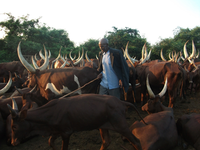
Lawrence Kayinamura and his family only moved into a real house in 1995. Before that, they were nomads, herding cattle through the broad plains of Ankole, living on the milk, blood and meat of their herds, erecting small huts of sticks and thatch for shelter, independent and self sufficient, even prosperous. Because it was the wealth of his herd that let Lawrence make the switch from nomad the homeowner. He traded part of his herd for a piece of land in Rakai district, just outside his Ankole homeland, then settled into a different routine, taking his cows out every day to his 60 acres of grass and bush, with a bore hole well for watering, and some stables and enclosures to keep his herd every night.
I was there one day as dawn broke on the sleeping herd, and Geoffrey scooted around from cow to cow, taking the morning’s milk, which nourished the humans in this family, as well as the calves. Lawrence walked among the drowsy cattle looking for any signs of disease or discomfort. He had lost 12 cows recently to malaria, and didn’t want to lose any more. The heat of the sun here, just a few degrees south of the Equator, was hard on the cattle too. In half an hour most of the herd was on their feet, anticipating the morning foray into the wild pasture outside the enclosure. The huge placid beasts were pretty quiet, with only occasional lowing. When they moved together, their huge horns clattered softly against each others, like soft, off-beat maracas.
It was the morning routine.
I was visiting Lawrence's farm near Mutukula on the Tanzanian border with my friends Mathias and Jovia Tusiime. Lawrence is Jovia's dad, and she was raised in the Ankole cattle culture with her 15 brothers and sisters.
The Ankole used to bleed their animals and drink the blood, or cook it into a solid cake, (tasting something like liver, Mathias said). But with the increased use of vaccines and anti-biotics, it’s no longer safe for people to ingest cows blood. Milk and meat are still ok, though. Lawrence and Edisa raised 15 children while they tended the cattle, though not all of them survived childhood, and two of the boys did not survive adulthood. Some of the boys went to school. But Jovia, Mathias’ wife, left school after primary 3, because at the time, her family lived pretty far outside the cash economy, they couldn’t afford school fees, and they never stayed in one place long enough for the kids to go to school.
Now, Lawrence is 73, and I think he’s glad he doesn’t have to wander endlessly with his cows. But he built a little hut across the highway from his house, and he stays there with the cattle when he has to move the herd to the pastures across the road.
The house is modern, with standard Ugandan architecture; metal roof, built from bricks made on site. But it still doesn’t have electricity, despite high tension power lines passing 100 feet away. There’s no running water either. When I asked for a glass of water, I was offered milk. The milk is delicious. Thick and creamy, usually served hot.
More photos from my visit to Lawrence and his family in my facebook album.
Paulo Kasumba has no cell phone and no fixed address, so I can never find him, but he seems to know when I am back in Uganda, because within a few days he shows up at my door with new songs, and new plans to cut a cd so he can break into the commercial music market.
He’s one of the most remarkable characters I’ve met in my visits to Uganda, an itinerant street musician who wanders the roads and byroads of this sprawling city playing his songs on street corners, in market places, and anyplace he can gather a crowd.
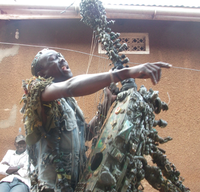
He’s bizarrely dressed…in a style something like a forest satyr with boots that look like they were sculpted out of moss, and tattered jeans and shirts. He wears sunglasses with only one lens and a beaded headband. He carries a vicious looking homemade slingshot in his shirt, that he takes out to ward off thieves and ruffians who sometimes plague him. Wandering the streets makes Paulo an easy target for petty robbers who would attack him even for the small change he has collected on a day of wandering and busking.
Paulo writes his own songs, that fit perfectly his husky voice and his rap style of delivery…he’s like a pure version if hip hop. He writes about sex, politics and God with equal intensity and frequency. He also makes his own instruments…called adungus. The adungu is an 11 string harp, a traditional Ugandan instrument that is habitually played in Ugandan ceremonies and dance performances. But Paulo has re-conceived the instrument…his current adungu is over 7 feet long and weighs about 65 lbs. Its so big he can’t fit it into a taxi cab, but can occaisionally be seen riding on the back of a boda boda carrying the enormous harp, creating the impression of an otherworldly vehicle careening down the crowded street.
Traditional adungus are made of plain wood and animal skin stretched over a hollow body. Very little decoration or style is involved. They’ve been made the same way for centuries. But Paulo’s adungus are elaborate almost phantasmagoric creations of color, melted plastic, lots of jingling metal junk, straps, suitcase handles, interesting street trash, model soldiers and guns, bottle caps. But they still have the basic 11 strings with friction tuning pegs, and a stretched animal skin under all that decoration and personalization that Paulo has added.
Paulo hasn’t adapted well to modern civilization. He’s illiterate. Doesn’t speak English, an official language of Uganda, and a standard requirement for commerce, government, education. He lives day to day, and has never held a salaried job. He couch surfs with friends and relatives, and has never had a permanent place to call home since he left his village 20 years ago. His life style would easily fit into the pre-colonial patterns of life..the wandering musician or troubadour, moving from village to village…singing for his supper . He’s never driven a car or received an email. He can use a cell phone, but has never had a phone number. He’s enormously inventive and creative, but has never found a wide audience, because his medium is personal and intimate. No tv screen, or even radio speaker separates Paulo the person from his audience, and consequently his audience is too small to support him very well. He’s totally charming and engaging, full of jokes and good humor, and at the slightest urging he’ll burst unto song.
As I said, he’d love to make a cd. Also he dreams of having a place of his own where he can have a workshop to make adungus and other musical instruments to sell.
If I could figure out a way to help him, I would. But for now, I;m just enjoying the music.
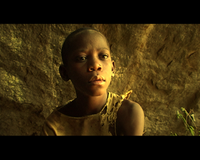
Stone Cold, a new movie by emerging Ugandan film producer Tri-Vision focuses on a father who forces his school age children to work full time in domestic service and in a stone quarry. Tri-Vision co-founder Joseph Kakembo describes Tri-Vision as "Something like an NGO, because we are trying not just to make films, but to develop the film industry in Uganda, training people and establishing standards. The standards set by Stone Cold are quite high. The film uses professional actors and skilled professionals in in every phase of production including lighting, cinematography, sound, sets, costumes editing. SEE A SIX-MINUTE TRAILER
The actors are paid, but the film crew is not. In fact the technical staff all contribute from their own pockets to finance the production of their movies. Stone Cold is the third Tri Vision film.
STONE COLD
A Trivision Uganda film in association with Raising Voices
Press pack
Directed By
Irene Kulabako Kakembo
Produced by
Trivision Uganda
Written By
Michael Wawuyo
Starring
Isaac Muwawu
Maureen Kibuuka
Ivan Kasozi
Milly Nalukenge
Shakira Nabuunya
Deo Mpindi
Also Featuring
Abbey Mukiibi and Kwezi Kaganda
Contact: Irene Kulabako 0772 700054
trivisionproduction@gmail.com, k2media2001@yahoo.com
information
Running time: 1 hr 10 mins
Aspect ratio: 16:9
Audio: Stereo
Screening format available: PAL DVD
Category: Fiction film
Shooting format: DV Cam
Note: A trailer and stills can issued on request
Partners: Johns Hopkins Bloomberg School of Public Health
Synopsis:
Based on true events, “Stone Cold” follows the life and family of a man called Kosai. He is a poor man who lives in a rural country side and earns a living by subsistence means -breaking stones by hand in a stone quarry.
In a desperate desire to complete a clients order for stones, Kosai removes all his four children from school and takes them into a forbidden and dangerous spot to break stones.
The story reveals the dangers, overcrowding, congestion and struggles that accompany life in a stone quarry. In the end, Kosai pays the price for his decision.
The film was shot in Kumi- North Eastern Uganda and in Kampala.
This film project was started in 2008 by a team of Ugandan independent filmmakers and will be launched on June 17th 2011 to mark the world day against child labour.
Activities scheduled around the premiere.
May 27th 7.00pm Media screening (press conference)
June 17th 6.00pm Stone Cold film Premiere
5pm – 9pm Exhibition by stakeholders and partners
June 18th 10.00am - 5pm Free film making workshops on Camera,
lighting for film and film financing
June 19th 2.30 – 3.45pm Free public screening of film- National Theatre
4.00 – 5.45pm Free public screening of film- National Theatre
6.00 – 7.15pm Free public screening of film- National Theatre
7.30 – 8.45pm Free public screening of film- National Theatre
Free tickets available from 6th June at National Theatre
The Filmmakers
We are a team of Ugandan independent film makers with a passion of growing the Ugandan film industry. We have come together under one umbrella – Tri Vision. Our objective is to bring quality educational video stories about Uganda to as many people as possible through mass media. We have produced 3 educative films so far which have been used for urban and rural community workshops and outreaches by - Johns Hopkins University Center for Communications programs – HCP, OXFAM, WORLD VISION, GOAL Uganda, ACTIONAID, Center for domestic violence prevention, Raising Voices, Health Initiatives in the private sector, Ministry of Gender, Uganda Police, Uganda Prisons and CORE initiative. Just to name a few.
Irene Kulabako Kakembo
Health Communication Specialist, film Director, Actress, TV Talk Show Host and last but not least – a Mother. She has a wealth of knowledge and over 15 years experience in Health Communications, Marketing and the world of media
Godwin Simon Opuly
Godwin has one great love - His Camera!
His vision has earned him multiple credits in countless video dramas, television series, commercials, and documentaries. With recognized works for CNN, NBC, SABC and BBC..just to name a few…….
Joseph Kakembo
Joseph brings his deep television and video drama production experience to Trivision Uganda. He has lit many TV game and talk shows and documentaries.
An accountant by day, a lighting director by night, and a husband 365 days a year!
credits
Starring
Isaac Muwawu...............................Kosai
Maureen Kibuuka ...........................Maliza
Ivan Kasozi.......................................Mariko
Shakira Nabuunya........................Besi
Deo Mpindi.....................................Yeko
Milly Nalukanga..............................Ketu
Joseph Walugembe...................................Nkodo
Kwezi Kaganda..................................Simolo
Quarry Master...............................................Abbey Mukiibi
Make-Up and Hair Designer
Michael Wawuyo - Senior and Michael Wawuyo- Junior
Costume Designer
Flavia Ndagire Kazibwe
Continuity
Sophie Matovu
Writer
Michael Wawuyo -Senior
Sound recordists
Shantos Sekito, Derrick Kibisi, Hassan Wamala
Music by
Enock Kislev
Ham Kay
Sam Bisasso
Rachael Magola
Production Designer
Joseph Kakembo
Director of Photography
Godwin Opuly
Directed by
Irene Kulabako Kakembo
Special thanks to
Raising Voices , Stone Concrete, Alliance Francaise, Uganda National Cultural Centre,
Uganda Museum, Nyero Rocks management, Kumi District, PEPSI, Fenon Entertainement
Health Communication Partnership, Native films, PABLO,
Platform for Labour action, WAYSand
The International Labour Organisation.
END
SEE A 6 MINUTE TRAILER
At a quarry in Kajjansi between Kampala and Entebbe I met several children who work full time crushing rocks for a living. The sturdier kids work below ground level, with sledgehammer, wedges and picks to break chunks of rock off the rock face. The chunks are sent up topside where crews of adults and children, often whole families, sit on the ground hammering the big chunks to break off smaller pieces for use in paving and concrete making. There is a compulsory education law in Uganda, but at least 15% of school age children are working full time and are not in school. Even the free public schools require some fees for books and materials and food. Many families cannot afford even these minimal fees. See more pix in the gallery.
I'm in Uganda again 2 years later. I'm here mainly to supervise the Uganda Art Consortium projects and to see if I can kick-start the radio station plan. I'm also checking in with a couple of kids who I'm helping with school fees. And I'm hanging out with old friends, doing some carpentry at Kisa School and generally making a nuisance of myself. I've also filed two radio stories, one on Freedom of the press which was aired on KBCS, KPFW and KSER last week. archived on KBCS. My story is about 20 minutes in from the start of the program. I just filed my second story about gay rights activists in this worst place in the world for gay rights activists. It should air on KBCS June 2.
The photo is of me, Jimmy Kibuuka and Andrew Musoke at an "introduction ceremony" an important Buganda cultural tradition which takes place before a wedding.
I made a side trip to Rwanda in May, to attend the Arts in Health Care-East Africa conference with some of my colleagues from Uganda Art Consortium. More later.
http:
Just before I left Uganda in October, I was able to organize a two-day workshop with children in the Namungona neighborhood in Kampala, and another workshop at the Infectious Diseases Institute at Mulago hospital. Here's a video of the Namungona workshop.
I just got back home from 8 weeks in Uganda and a week in Pakistan. In Uganda, I stayed at Kisa school and did some volunteer work there. (see recent Photos in the gallery)
Art Workshops
I also spent time on Uganda Art Consortium business...organizing art workshops at a primary school in Namungona and at the Infectious Diseases Institute at Mulago Hospital in Kampala. Over 125 kids and 200 patients at Mulago attended the workshops. Another workshop was planned for the childrens' wards at Mulago this week, but I haven't heard yet how it went.In my luggage I brought back about 50 oil paintings and other artworks for the show in Washington D.C. at Howard University in February 2010. I'm cautiously hopeful that two of the artists, Matias Tusime and Hassan Mukiibi will be coming to Washington for the show.
The Radio Project...to build a community radio station in Kyotera in Rakai District where the AIDS virus first appeared in Uganda...is on hold because of the riots in September. Let me explain. The week I arrived in Uganda, street demonstrations in Kampala and several other central Uganda towns were broken up by the police. Over 20 people were killed, 600 arrested, 5 radio stations shut down and more than 20 journalists arrested on sedition charges. The protests were about a dispute between the federal government and the Kabaka (king) of Uganda...a traditional kingdom that is part of Uganda. The government wanted to curtail the Kabaka's right to travel within Uganda. The protestors objected. Anyway in the wake of the riots, the govt. decided not to issue any more new radio licenses. We had applied last January for a license for Rakai Radio, and felt we were on the verge of getting it. I had hoped to spend part of my visit there doing some initial organizing work on the station. But now its not clear when a license might be issued. Govt. is clamping down hard on all media, and the ruling party is going to be on edge until after the elections in 2011. I'm afraid we might have a long wait before we get our license.
Radio Stories
While in Uganda I reported several stories which were broadcast on WPFW in Washington DC, KBCS in Seattle and KSER in Everett WA. I reported on the riots, then a separate piece on press freedom. I also produced stories on the work of a group of AIDS volunteers, and on the contentious issue of the tradition of bride price in Uganda. A group of men and women are suing in court to stop some of the worst abuses of bride price which has led to women being sold like commodities the highest bidding suitor.
Here are links to the stories:
Kampala Riots
AIDS Volunteers in Uganda
Press Freedom in Uganda
Bride Price Vs. Womens Rights in Uganda
Food Price Inflation
Tororo Wedding Music
I also produced a video of a visit I made to Tororo, about 200 miles north of Kampala of a performance of traditional wedding music and dancing by a group that was arranged for me in Magoro village near Tororo about 200 Km north of Kampala.
You can see the video here.
Pakistan
I departed Kampala Oct. 28 and flew to Islamabad, Pakistan to spend a few days with my friend Tarik Zia and his family. Tarik is a TV reporter in Islamabad, and his wife Masooma is a teacher. They have a precocious 4-year old, Daniel. They live with Masooma's parents, Said and Saeeda Ul-Haq in a suburb of the city. Tarik took me to his newsroom and introduced me to his colleagues. I interviewed one of the reporters who had just returned from being embedded with the Pakistani army in South Waziristan conducting operations against the Taliban and Al-queda. I'll be producing a radio story on that interview later this week. Pakistan was hit by two more major bombings while I was there...one in Peshawar in a crowded market that killed 150 people and another in at a bank in Rawalpindi, a suburb of Islamabad, the day before I left which killed 35. As a result of the continued terror attacks, everybody's pretty tense. Special security measures have been taken at all schools including guards, blast walls and barbed wire. Daniel's school has been closed for two weeks because they haven't completed their security upgrades yet. There are military checkpoints on all major roads, and retail trade is down substantially.
Lahore
We took a trip about 400 Km north to Lahore, the ancient capital of the Moghul Empire, and today a bustling thriving industrial and commercial city. It's full of culture including restored palaces and mosques, Punjab University and excellent food.
One of this country's most colorful features is that almost all big trucks and many busses and other commercial vehicles are elaborately painted and decorated in elaborate traditional designs...I mean every inch of the truck inside and out is decorated, with bells hanging from the mudflaps, and elaborate prow-like structures jutting out over the cabs. So Tarik took me to visit a big outdoor workshop in Rawalpindi where the fancy trucks are built and rebuilt and painted and decorated. Here are some pictures of the painting and other work being done on the trucks. I think I'll make a video or a radio story about it when I get home.
Judging from the two urban areas I visited Pakistan seems modern and thriving and very energetic once you are outside the capital. But there are vast areas of rural poverty that suffer from lack of schools, infrastructure and social services. That's where fundamentalist revolutionaries are making their biggest strides, taking over local government...providing schools chasing down criminals, and murdering local government officials they deem corrupt or insufficiently religious. That's where the country's future will be decided. The Pakistani government has a long way to go just to win the hearts and minds of most of its own people.
Uganda: Problems and Prospects
Uganda has been hard hit by food price inflation...over 50% in 2009 alone for many staples... and many are getting less to eat and paying more for it. Wages haven't increased at all. Unemployment has increased too, though it's hard to measure because the newly jobless usually try to scrape together a little capital and peddle used clothing or vegetables or housewares on the road or at a small roadside stand. Most people have some relatives back in their home village, where they can go if things get too bad. Some of the rural areas though have been hit by drought and floods. And in the North, agriculture has never gotten back to normal after the devastation on LRA wars that ended a couple of years ago. Government is just now getting serious about forcing people in the IDP camps to go back to their home villages and plant crops. Overall, I'd say Uganda is in a little worse shape than my last visit in 2007. Most people I met are angry at the government for incompetence and corruption...anger that fueled the September riots. But I don't think the current government is in any danger of overthrow or defeat at the polls. The army was built on the guerrilla forces led by Yoweri Museveni who is now the president, and most of the generals are Banyankole like him. Museveni, of course, also appoints the electoral commission that will set the rules and certify the results of the 2011 elections.
Union Organizing Drive
One more thing...In the last few days before I left, I tried to set an union organizing drive in motion. A Ugandan friend is a field rep for a local micro lending agency. When she told me about her deplorable working conditions I got her together with organizers from COFTU one of the two national labor federations. COFTU sent six staff people including the Organizing Director and a General Secretary to the meeting with my friend. A meeting with a larger group of workers is scheduled for this week. Turns out that Ugandan labor law is pretty strong...in many ways better than our NLRB. Recognition is automatic even if only a minority of workers sign up, and there are stiff penalties for employers who trample workers rights. The wage earning labor force (industrial, teachers and civil service) is small, but 15% now belong to unions. The vast majority of workers are in the informal sector ...small retail, day labor and contract workers like security guards and taxi drivers. But COFTU is opening a major effort this year to organize these workers.
http:/ / www.bcc.ctc.edu/ kbcs/ downloads/ One_World_Report/ OWR_20090917/ OWR_20090914_Uganda-protests- TH_Edit2.mp3
Last week made another trip to Tororo where some wonderful people put on a lovely performance of traditional Japadola wedding music. Check out the You Tube video: http://www.youtube.com/watch?v=POQBUG4Vd1M
The Ugandan Government has been cracking down on radio stations and journalists in the wake of violent clashes between police and protesters in early September.
Uganda has a diverse, vibrant media scene with over 50 radio stations, three TV networks and a mix of daily and weekly print publications. Press freedom expanded greatly in 1986 when the current government took power and guerrilla leader Museveni became president musette.
But government is blaming the media for instigating and stoking the protests which swept through central Uganda early in September. Five stations had their licenses yanked in a broad warning to media throughout the country to watch their mouth when it comes to politics. At least 20 journalists, photographers working the street protests were arrested during the violence
A popular talk show host was jailed and charged with sedition, and new bill has been introduced in Parliament to license journalists with the ability to pull the licenses if the government objects to their reporting.
Despite periodic government efforts to muzzle the media, the nation has a strong tradition of independent journalism.
Peter Mwesige's column in the monitor was canceled several years ago under government pressure when he criticized the ruling party. The former columnist and journalism professor is now a media consultant. He told me government attacks on the press will continue and become fiercer as we get closer to the 2011 elections. There's widespread dissatisfaction because of economic issues, and Museveni's re-election strategy will feature rigging votes and silencing dissenters, Mwesige said.
Andrew Mwenda is founder and editor of the Independent Magazine which has been a persistent critic of President Museveni and the ruling NRM party since it was founded in 2007. I was able to interview him just a couple days before he was scheduled to appear in court on sedition charges. He cheerfully quoted to me the motto on the back cover of every issue: “You Buy the Truth, We Pay the Price.”
Mwenda says he expected government would try to silence him when he founded the magazine in 2007. So it didn't come as a surprise when he was himself charged with sedition after he wrote unflattering comments about President Museveni in an editorial.
The government attack on the media is "A sign of weakness...the last kicks of a dying horse," he told me. He says Museveni's winning margin has steadily declined in the last three elections, and that its virtually impossible for him to win without a run-off. The 18-30 age voters are a majority, and won't vote for Musevini, Mwenda says.
Mwenda was charged with sedition weeks before the September riots. He responded to the charges by filing a lawsuit in constitutional court claiming his right of freedom of speech was threatened. The sedition case can't be heard until his constitutional claim is ruled on.
I also interviewed a top government official...the Minister of State for Ethics and Integrity who told me this whole idea that journalists should be allowed to write or say anything they want is "Very Strange." The Minister, James Nsaba Butoro says western ideas of media freedom are not appropriate for Uganda. He likened the Kampala protests to the Rwandan genocide, and said the government had to act quickly to avoid disaster. He told me the government should train, license and supervise all journalists.
Its hard to believe the government is serious about the licensing law, but its clear that threatening and intimidating the media is part of their election strategy. So far they haven't intimidated Andrew Mwenda who told me the Sedition Law, under which he is charged for defaming Pres. Musevini is unconstitutional. "I broke the law yesterday," he said, "I break it today and I will break it again tomorrow."
Aids is on the increase again in Uganda, despite years of effort, and strong signs that the infection rate was declining. In 2008, 7.5% of the population was infected, up a full percentage point from just 3 years ago.
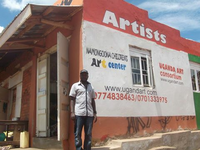
The A to Zed Childrens Charity In Wakiso District works with over 400 children including orphans, children born with aids, and families struggling to escape poverty.
Aids once infected nearly 15% of the population. Hard work in the last 20 years brought that figure down dramatically to 6.5 % in 2006. Now it is on the rise again...to 7.5 % of the population in 2008.
Over half the population in this area is under 18, and nearly one in five of those children have lost one or both parents....many of them to HIV. HIV appears to be spreading most among married couples, with the result that thousands of children each year are born with HIV, and then their parents die.
Wakiso is a semi-rural area within easy commuting distance of Kampala. The population has doubled here just in the last 10 years. Several local grass roots organizations supported by international donors and NGOs have organized to help deal with the aids crisis. The groups work together to provide services and education to children and their parents dealing with HIV-Aids in their families.
A-Zed pays school fees for over 200 children whose parents cannot afford them. 200 more children are part of another A to Zed program which provides family counseling on HIV and other health problems, and financial management training and business loans for parents. One of the biggest problems for families needing health care for HIV is the simple matter of transportation to the hospital.
Volunteers work with the families to help them cope with the challenge of living with HIV Aids. Teddy Nansekka is one of those volunteers:
Teddy is one of the most successful volunteers in the program. She develops great rapport with her client families when she tells them that she too is living with aids. Teddy contracted AIDS when she was raped by a soldier during a period of intense fighting in her village in 1990. She was stunned when she learned she was HIV Positive.
Gradually, with the help of her family, her pastor, and sensitive counselors, she learned how to live with her diagnosis, and thrive and lead a fulfilling life. She's raising her own two children as well as her niece and nephew who were orphaned when Teddy's sister died of AIDS a few years ago. She supports herself selling vegetables from a roadside stand, and from hand crafted jewelry she makes in her HIV AIDS survivors group.
But she also felt a need to help others in the same situation.
Betty Muhangi is a volunteer with TAAPA another organization working to help AIDS families in Wakiso.
Muhangi thinks aids is on the increase because the government and community groups relaxed when the first declines in new infections were posted.
Muhangi says the Ugandan Government needs to increase its efforts in public education and to provide more support for groups like TAAPA and A to Zed.
Another local NGO working against AIDS in Wakiso is KIFAD. KIFAD, trains AIDS victims in new job skills so they can support themselves and their families. Many survivors of the HIV AIDS epidemic are single mothers with few job skills. Kifad just celebrated the first graduates of its tailoring class. 20 women from families hit by AIDS were trained in a year long program to be skilled tailors. A new class with 18 students started the following week
Kifad, Taapa, A to Zed and other grass roots organizations here in Uganda share the goal of empowering HIV Aids victims to take control of their disease and their lives. With funds from international donors and energy from local volunteers they are struggling to stem the growing tide of HIV Aids.
Listen to the full story on KBCS: http://www.bcc.ctc.edu/kbcs/downloads/One_World_Report/OWR_20090924/OWR_20090922_Uganda_AIDS_TH.mp3
In the Photo, Teddy Nansekka and her niece Elizabeth.
Nansana, Uganda Sept. 19
Yesterday I set out to find Josephine Namuwawu, the young woman that Sally Donart, Gretchen's mom and I have been helping with money to pay her school fees. Josephine, 18, is one of three siblings. Their Mom died last year, and the kids kept the house, but have little income except what the 17 year old brother can bring home from casual construction jobs. Josephine and her younger sister Justine have been in school at St. Elizabeth's, but Josephine had to stop going because she had no money for fees. Justine would soon have to drop out because she can't pay this years fees. The fees are about $80 for each three month term plus a little extra for shoes, uniforms etc. I went out to the school, St. Elizabeth's. It's a highly regarded secondary school in Wakiso and most of the graduates go on to university. I asked the head master to help me find Josephine. After interviewing a few of her friends, we found her sister Justine in class. She has a different last name, so the school didn't realize they were sisters. Justine was called out of class me and told us that Josephine was at hoe and didn't have a job. Fortunately the girls live near the school. Justine led me through some dusty back lanes about 1 km away and we found Josephine at home in their neat little two-room brick house. She was actually studying her lessons against the time when she might get back in school. We all trooped back to the school together, and I got Josephine signed up to start class again on Monday. I also learned that Justine hadn't paid fees for this term, and Josephine owed for last term as well. I paid all the outstanding fees, so both girls are back in good standing. There was enough money in Sally's gift to buy the girls some new shoes, to pay for Josephine's last term final exams, and to leave them with a little spending money. I now have good contact with the headmaster, so I'll be able to make sure the girls stay in school.
Kampala, September 13, 2009
The streets of Kampala, Uganda's Capital were filled with smoke and violence Thursday and Friday last week, as thousands of demonstrators protested the federal government's efforts to restrict the movements of the Kabaka, or king of Buganda.
Uganda has for years been considered one of the most stable and peaceful African Countries, but the capital Kampala and a wide surrounding area exploded Thursday in violent clashes as police and army units fought demonstrators protesting government efforts to restrict travel by the Kabaka, head of the traditional kingdom of Buganda.
At least 20 people have been killed and hundreds injured and arrested. The government ordered 5 radio stations closed for inciting violence including three stations owned by the Kingdom of Buganda. A popular radio talk show host was arrested and the Uganda Journalists Association said the police have been targeting and assaulting reporters covering the violence.
I witnessed some of the violence In downtown Kampala Thursday morning as demonstrations were broken up by police and soldiers. In response, demonstrators, known as Nkobazambogo, or Buganda youth vigilantes, set fires and barricades in the streets and pelted police with rocks and and bottles. Police charged and chased demonstrators down the narrow downtown streets around the taxi parks, firing teargas, and beating and clubbing demonstrators and bystanders alike. By mid-day, protests had spread widely throughout the city and the surrounding suburbs. Virtually all major roads were barricaded and traffic including busses and taxis came to a stand-still for the rest of the day. Thousands of weary workers trudged for hours in the dark to reach their homes.
The origins of the current dispute this week date back over 100 years when Buganda and three other traditional monarchies were stitched together by British colonialists to create the modern state of Uganda. The kingdoms, Buganda, Bunyoro, Toro, Busoga were allowed to keep the trappings of royalty and a shadow of statehood but with limited legal authority when the current Uganda government was formed in 1992.
The protests were sparked when President Yoweri Musevini said the government would not allow a proposed visit by the Kabaka on Saturday to the town of Kayunga. Kayunga is in an area that was taken away from Bunyoro Kingdom in the 19th century by the British, and annexed to Buganda as a reward for cooperating with the colonial rulers. Both Bunyoro and Buganda claim the area today.
I made my way home in the early evening on the back of a boda-boda, a small passenger motorcycle, a cheap, fast and often thrilling form of public transportation in Uganda. The Boda could go where cars were blocked and my driver nimbly steered us between rocks and concrete chunks stacked in the road, piles of burning trash and tires and abandoned vehicles. At several points along the way we were stopped by demonstrators and urged to offer cash contributions to the Kabaka before we could continue on our way. Vehicles that tried to pass through the barricades without stopping were pelted with rocks. As I alighted from the boda-boda, gunfire exploded less than 100 yards away, as army units crashed through a street barricade, firing their guns in the air. About two dozen demonstrators and spectators scattered and ducked for cover.
The protests brought substantial hardship to many families, even those not touched by the violence. Virtually all Shops, factories and offices closed out of fear of the spreading violence.
Jimmy Kibuuka the director of Kisa Primary School where I am a volunteer is a leader in the Democratic Party, one of three minority parties opposing the ruling NRM headed by President Museveni. He says the government is using the disturbances to harass Democratic Party leaders. Several of his DP colleagues in Nansana have been arrested in the last 2 days.
Late friday night the Kabaka insisted he was going to Kayunga the next day, and President Museveni vowed he would not. But Saturday morning the Kabaka blinked, and announced he will postpone his trip.
This defused the protests, and there was only scattered violence Saturday. Most roads were cleared and it was possible to travel in and out of the capital. But the police announced they will continue to arrest those they call leaders of the protests in the next few days. As the smoke clears in Kampala and a shaky peace returns, all the underlying tensions and conflicts remain virtually untouched, and the prospect of further confrontations remains very strong. More photos here.
|
|